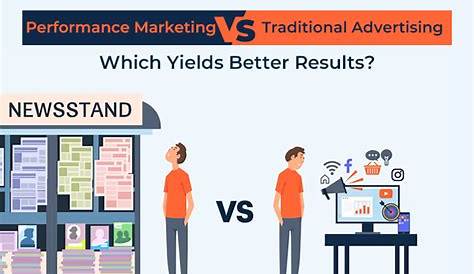
Performance marketing is usually bought and judged by measurable actions, while traditional advertising is usually bought for exposure, placement, or audience reach. A paid search campaign might charge when someone clicks and let you connect that click to a sale; a billboard is normally purchased for a period, location, or estimated audience. Neither approach automatically wins: performance marketing offers faster feedback and tighter control, while traditional advertising can build familiarity and demand that digital reports do not fully credit.
1. Is performance marketing really that different from traditional advertising?
Yes. The main difference is how the campaign is bought, measured, and managed—not whether it uses the internet.
Performance marketing is organised around an action: a click, lead, app install, completed purchase, booking, or another defined result. You can usually see results during the campaign and shift budget toward placements, audiences, or messages that appear to work.
Traditional advertising generally buys access to attention. You pay for a television spot, radio schedule, print placement, billboard, or sponsorship because it reaches a particular audience or occupies a useful location. The intended result may be greater awareness, more store visits, stronger reputation, or future demand rather than an immediately recorded conversion.
That difference changes the questions you ask. A performance marketer asks, “How many qualified leads did this campaign generate, at what cost, and how many became customers?” A traditional advertiser may ask, “How many people in our service area saw or heard this message, and will they remember us when they need us?”
The categories overlap. Digital display advertising can be bought for impressions and used mainly for awareness. Direct mail can include a trackable code and be managed like a response campaign. A television ad may include a memorable web address and produce measurable visits. Think of performance and traditional advertising as ends of a measurement and buying spectrum, not sealed boxes. Performance channels tend to offer faster feedback; traditional channels often provide broader or more contextual exposure.
2. What counts as performance marketing, and what counts as traditional advertising?
Performance marketing commonly includes paid search, social advertising optimised for leads or purchases, affiliate campaigns, comparison-shopping ads, display retargeting, and some email or partner programmes. In each case, the advertiser defines an outcome and uses reporting to judge both the cost and the quality of that outcome.
For example, a plumber might pay a search platform to appear when someone searches for “emergency plumber near me.” The campaign may be judged by calls, quote requests, booked jobs, and profit—not clicks alone. An online retailer might pay an affiliate a commission for orders generated through a tracked link. A software company might buy social ads to generate trial sign-ups, then compare the eventual subscription rate by audience and creative.
Traditional advertising includes television, radio, newspapers, magazines, billboards, cinema, printed flyers, direct mail, sponsorships, and many local event placements. A restaurant could buy a month of roadside billboard space. A law firm could sponsor a local radio programme. A manufacturer might purchase a trade-magazine spread to reach business buyers. These campaigns can include response mechanisms, but the placement itself is usually the main product.
There are grey areas. Direct mail can be highly measurable if each audience receives a different code or web address. A social campaign bought by impressions may be traditional in its objective even though the channel is digital. Conversely, a radio advert with a unique phone number can be evaluated more like direct-response marketing.
The useful question is not simply whether the campaign is online. Ask what action you are buying or optimising for, what evidence will show that it worked, and how quickly you can change it if the evidence is poor.
3. Do you pay for clicks and sales, or for people seeing the ad?
Performance campaigns often use action-based pricing, although the advertiser may still pay for impressions behind the scenes. Common models include:
- CPC, or cost per click: you pay for a click on an advert. This is common in search and some social campaigns.
- CPA, or cost per acquisition or action: payment is tied to a defined outcome, such as a sale or completed application. The exact arrangement depends on the platform or partner.
- CPL, or cost per lead: you pay for a submitted enquiry or other lead event. A cheap lead is not necessarily a valuable lead.
- Revenue share: a publisher, affiliate, or partner receives an agreed percentage of the revenue from tracked sales.
Traditional advertising more often uses CPM, meaning cost per thousand impressions, a flat fee for a placement or campaign period, a sponsorship fee, or a negotiated media-buying cost. A radio station might sell a package of spots. A magazine might charge for a page. A billboard operator might charge for a fixed term in a particular location. The price reflects audience estimates, scarcity, placement, production, and negotiating power.
The labels overlap. A social platform can sell impressions while you optimise for purchases. A performance agency may charge a monthly fee rather than a percentage of sales. A traditional publisher may offer a response guarantee or include tracked digital placements in a package. Pricing alone does not determine the category.
The key budget question is who carries the risk. With a flat placement fee, you bear more uncertainty about response. With CPC, you have more direct control over traffic costs but may pay for visitors who never buy. With CPA or revenue share, the partner may carry more delivery risk, but the rate can be higher and the rules stricter. Read the definitions carefully: a “lead” could mean a form fill, a phone call of any length, or a qualified sales opportunity, and those are not equivalent.
4. Which one lets you see exactly what your money produced?
Performance marketing usually gives you a clearer chain from exposure to action, but “exactly” is too strong. A properly configured search campaign can record an ad click, landing-page visit, form submission, phone call, sale, and revenue. You can compare campaigns by cost per lead, cost per customer, conversion rate, and return on ad spend. That visibility makes budget decisions easier.
Suppose a kitchen installer runs separate search campaigns for “new kitchen quote” and “kitchen repairs.” The business can attach tracking details to each click, record which form or call resulted, and later connect closed jobs to the original campaign. The picture may still be incomplete, but it is more direct than guessing from total enquiries.
A billboard works differently. People may see it, remember the company, and search for the brand two weeks later. A last-click report may credit that later search even though the billboard helped create the demand. Someone else may visit the shop after seeing the sign but never use a trackable link. Traditional campaigns can be measured with brand surveys, audience estimates, unique phone numbers, promotional codes, location comparisons, direct-traffic changes, or matched geographic tests, but none provides a perfect record of every influence.
Digital measurement has gaps too. Browser restrictions, consent choices, blocked cookies, device switching, offline sales, platform reporting differences, and incomplete customer records can break the chain. A platform may claim credit for a conversion that would have happened anyway, especially if it reports view-through or broad attribution windows.
Treat attribution as evidence, not a courtroom verdict. Track the first enquiry, sales-qualified lead, closed sale, revenue, refund, and repeat purchase where possible. Compare platform reports with your own customer and finance records. If you measure only clicks or form fills, you may optimise for cheap activity instead of profitable customers.
5. Why performance marketing can be changed while a traditional campaign is already running
Digital performance campaigns are usually easier to adjust because platforms can change bids, budgets, audiences, creative, and destinations quickly. If one search term produces many unqualified enquiries, you can add exclusions. If a landing page converts poorly, you can revise it. If an audience produces profitable orders, you can increase its budget, subject to platform limits and diminishing returns.
The feedback loop can be short. An online shop may see that a product ad receives traffic but few purchases, then test a different product image, offer, audience, or checkout message. A local service business can adjust its location targeting or schedule after seeing where calls originate. These changes do not guarantee improvement, and small data sets can mislead, but they are possible during the campaign.
Many offline placements are less flexible. Once a magazine has gone to print, the advert cannot be changed. A billboard contract may run for several weeks. A television schedule may require advance booking, and changing the creative can involve new production and approval costs. Radio can sometimes be altered faster than print or outdoor, but a new recording, schedule, and fee may still be needed.
That speed has a downside. Easy editing can encourage constant tinkering before enough conversions have accumulated. You may pause a campaign after a slow day, change three variables at once, or move budget based on platform data that does not match completed sales. Traditional advertising’s fixed commitment can force clearer planning, even though it limits correction.
Set a measurement period, a decision rule, and a testing plan. Change one meaningful variable when possible, record what changed, and judge results over the sales cycle rather than the first few hours. Speed helps; it does not replace sound evidence.
6. Does measurable mean performance marketing is always cheaper?
No. Performance marketing can reduce wasted exposure, but it can also become expensive when competition is high or conversion economics are weak. You may pay for creative production, landing-page development, analytics, call tracking, consent management, agency or freelancer fees, feed management, and marketing technology as well as media spend.
Auction-based channels can become costly as more businesses compete for the same searches or audiences. A click may be relevant but still fail because the offer is weak, the page is slow, the enquiry process is awkward, or the customer is not ready. Retargeting can spend money on people who would have returned without the advert. Automated targeting can find conversions while also reaching people who are unlikely to become good customers.
Surface metrics can hide the problem. A campaign with a low cost per click is not attractive if the traffic never buys. A low cost per lead may reflect poor-quality enquiries that waste sales time. Judge the result against gross profit, fulfilment costs, refunds, sales commissions, and the time required to close the customer. If a £40 lead produces a customer worth £25 in contribution margin, the campaign is not profitable, whatever the dashboard says.
Creative quality matters in both systems. Narrow targeting cannot rescue an unconvincing message, and broad reach cannot compensate for weak creative. Customer lifetime value changes the calculation too. A subscription business may accept a higher first-sale acquisition cost if retention is strong; a one-off, low-margin product cannot make the same assumption.
The fair comparison is not which channel has the cheapest media. It is which mix produces profitable incremental customers or valuable brand demand at an acceptable risk. Include setup and operating costs, then compare contribution over a realistic period.
7. When traditional advertising still does a better job
Traditional advertising can be the stronger choice when broad reach, local visibility, trust, prestige, or repeated exposure matters more than an immediately trackable response. A billboard near a retail location can remind thousands of passing drivers that the shop exists. A local radio sponsorship can make a business familiar within a community. A respected magazine or event can provide context and credibility that a small display advert may not.
Reach matters when people are not actively searching for your category. A new homebuilder, financial service, or consumer product may need to create awareness before customers develop a specific query. Paid search captures existing demand well, but it cannot capture much demand from people who do not yet know the product or problem.
Traditional placements can also suit businesses with a concentrated geography or audience. A clinic serving one town may value local outdoor advertising and community sponsorship. A specialist manufacturer may find a trade publication or industry event more appropriate than broad consumer targeting. Repeated exposure can build memory over time, even if few people respond immediately.
The limitations are real. Traditional campaigns often require larger commitments, provide slower feedback, and offer less precise individual targeting. Audience estimates may be modelled rather than directly observed. Production and booking deadlines reduce flexibility. Privacy changes affect digital and offline measurement differently, but no channel provides a complete view of human attention or influence.
Traditional advertising is not unmeasurable. Use unique landing pages, dedicated phone numbers, discount codes, store-location comparisons, customer surveys, and pre/post geographic tests. These methods will not capture every influence, but they can make an awareness campaign more accountable. A billboard or sponsorship should not be judged as though it were a last-click search ad; its job may be to make later response more likely.
8. Why the customer journey makes the comparison less simple
Customers rarely move from one advert directly to buying. Someone might hear a podcast mention, notice a bus advert, ask a colleague, search the brand name, visit the website, leave, receive a retargeting ad, and return through a saved bookmark. A last-click report may credit the final search or direct visit while ignoring the earlier demand-building work.
This matters because performance marketing often captures existing intent. If a television campaign makes more people search for your brand, branded search may look increasingly efficient. That does not necessarily mean search created all the demand; it may have harvested interest generated by television, outdoor advertising, public relations, referrals, or prior customers.
The reverse can happen too. A person may click a social ad, remember the company, and later buy in a shop. The platform may not connect the sale to the original interaction. Offline conversations, shared devices, privacy choices, and long sales cycles make the path difficult to reconstruct.
Use several views of performance. Keep platform-level reporting for campaign management, but also monitor total qualified enquiries, new customers, revenue, branded search, direct traffic, store visits where available, and sales by geography or time period. If the budget allows, compare areas or time windows with and without the awareness activity. A holdout or matched-market test can provide stronger evidence than simply comparing before and after, although it requires careful design and enough volume.
Attribution is a method for assigning credit under imperfect observation, not a single objective truth. A search-platform report can help you manage search bids; it should not alone decide whether a television campaign created value. The broader the customer journey, the more useful it is to combine channel data with business-level outcomes.
9. How should a small business choose between the two?
Start with the business goal, not the channel you happen to know. If you need bookings this month and customers actively search for your service, performance marketing may be a sensible first test. If you need to become known in a town, launch an unfamiliar product, or build trust before a long decision, traditional activity may carry more weight. Many businesses need both.
Assess the audience and sales process next. Performance channels work best when you can identify useful intent, reach a meaningful audience, and respond quickly to enquiries. A long business-to-business sale may still use paid search or LinkedIn-style targeting, but the final sale could occur months later and require offline tracking. A local shop may benefit from outdoor, local audio, maps, social, and email rather than one channel in isolation.
Check the economics before setting a media budget. Know your average order value, gross margin, repeat-purchase rate, sales close rate, and acceptable customer acquisition cost. If 20% of qualified leads become customers and each customer contributes £300 before marketing, a rough allowable lead cost must leave room for operating costs and profit. The exact threshold is yours, not the platform’s.
Check your measurement readiness and appetite for testing. You need functioning analytics, conversion events, call or form records, a way to identify closed sales, and a landing page that can do its job. If those pieces are missing, fix them before scaling spend. Choose traditional placements when you can define the audience or geography and tolerate slower feedback. Choose performance channels when you need fast learning and can act on the data.
- Define the outcome and time frame.
- Estimate the value of a new customer.
- Choose one measurable test and one brand or reach activity if both needs matter.
- Set a stop, continue, or expand rule before launch.
- Review profit and customer quality, not just impressions, clicks, or leads.
10. What a sensible mixed campaign could look like
Imagine a small home-renovation company serving three nearby towns. It wants more enquiries now but also needs local homeowners to remember its name before they are ready to renovate. A mixed campaign could use local radio or outdoor placements for broad recognition, supported by paid search for people actively looking for kitchen or bathroom work.
The awareness activity could feature a short, memorable message and a dedicated web address that is easy to say aloud. The company could also use a unique phone number or offer code for that placement. Those devices will not capture every response, but they provide more evidence than a general phone number alone. The campaign might include a simple local landing page rather than sending everyone to the homepage.
The performance layer could separate high-intent searches from broader research terms. Search ads would point to relevant pages with clear enquiry forms and call tracking. Retargeting could remind site visitors about consultations, provided consent and platform rules are handled properly. Email could follow up with people who requested a guide or quote, while a customer database records whether enquiries become site visits, quotes, and completed projects.
Success metrics should match the different jobs. For awareness, look at reach, direct and branded traffic, enquiries using the dedicated details, local search behaviour, and changes in qualified demand. For performance, track qualified leads, booked consultations, close rate, customer acquisition cost, contribution margin, and revenue. Review the combined result too, because channels may assist one another.
Start with a budget you can afford to learn from, not one that assumes immediate perfection. Keep the creative and offer consistent enough to compare results, but leave room to improve weak pages or messages. The goal is not to force traditional advertising to prove that every impression caused a sale, or to demand that performance marketing build a famous brand overnight. Give each channel a job, measure what can reasonably be measured, and judge the mix by profitable growth.
Conclusion
Begin with the customer action or business outcome you need, then make sure your tracking can see more than clicks. If demand already exists and your margins support testing, start with a tightly defined performance campaign and connect leads to actual sales. If the bigger problem is that people do not know or trust you yet, reserve budget for reach and repeated exposure rather than expecting search alone to create demand. Ignore dashboard numbers that do not survive contact with profit, lead quality, and customer lifetime value. A good result is not simply a low cost per click or a large audience; it is a clearer view of which activities create profitable customers, which create future demand, and how the two can work together.
Frequently Asked Questions
Is performance marketing better than traditional advertising?
Neither is automatically better. Performance marketing usually offers faster feedback, clearer action-based reporting, and more direct optimisation. Traditional advertising can build broad awareness, local familiarity, trust, and demand that digital reports may not fully credit. Choose based on your goal, audience, sales cycle, budget, and economics.
Can traditional advertising be measured?
Yes, although measurement is often less direct. Unique phone numbers, web addresses, promotional codes, customer surveys, store-visit comparisons, and geographic tests can show whether a campaign changed behaviour. They will not capture every influence, so treat the results as useful evidence rather than a perfect conversion count.
Is performance marketing cheaper for small businesses?
It can be easier to start with a controlled budget, but it is not always cheaper. Creative, tracking, agency fees, auction competition, wasted clicks, and poor conversion rates can make a campaign unprofitable. Judge the cost of acquiring a profitable customer, including margin and customer lifetime value, not just the cost of a click or lead.
Can a business use performance marketing and traditional advertising together?
Yes. Traditional activity can create recognition and demand, while search, retargeting, email, and tracked landing pages can capture and nurture people who respond. Give each channel a defined role and compare the combined business result rather than forcing every sale into one channel’s report.